
Here are some other articles that describe this disturbing problem the lack of drafting knowledge has caused in the Industrial/Mechanical Engineering industry today.
The Death of the Draftsman or “Where has all the talent gone?”
Should the New 3D CAD Engineer Learn Drafting?
Can Engineering Survive without the Drafting Group?
An associate sent me this article. I have been beating this drum for over a decade. It is nice to see someone else seeing this situation.
August 26, 2011
RE: In Search of the Mechanical Drafter . . . A message of notable value. I urge you to share with your HR or recruitment staff or clients who have engineering staffing needs pertaining to their engineering services or drafting department.
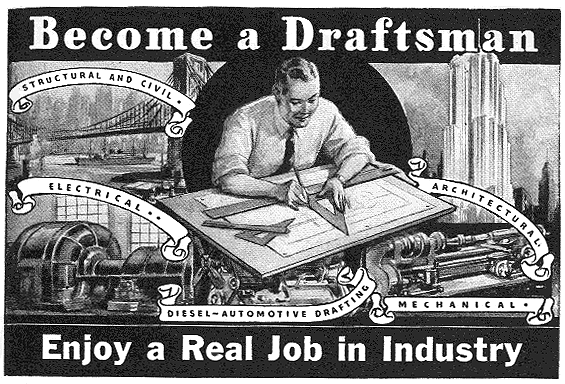
Today, for every 104 teachers instructing elementary grades; 88 are accountants, 50 are lawyers, 16 are mechanical engineers, 16 are taxi or chauffer drivers, and 5 are mechanical drafters. The 2011 Occupational Outlook Handbook forecasts the mechanical drafter profession to continue to decline. Prior to the personal computer, CAD and software related to engineering documentation, the old system, albeit manual, sufficed to create and bring to market a viable product. Indeed, the old school manner of paper tablet and pencil to sketch, and a drawing board to draw on vellum was cumbersome, but no more mistake prone than entering incorrect data into a computer.
1Beginning in the 1980s Computer-Aided Design programs reduced the need of draftsmen significantly, especially in small to mid-sized companies. Their affordability and ability to run on personal computers also allowed engineers to do their own drafting work, eliminating the need for entire departments. In today’s world most, if not all, students in universities do not learn drafting techniques because they are not required to do so.
In all fields of work, there are those who are trained for a job and those who are natural for a job. Those who drew freehand or by manual method were generally more creative and enjoyed the manual labor of technical drawing. One worked with their tools as an extension of their visionary mind. People who did not have keen 3D visualization and typeset-like penmanship did not enter the drafting field. Why would they when one had to be effectively neat. But the PC and CAD changed the drafting field to allow others to do CAD drafting, who would not have entered the field otherwise. Today, many view the computer as a “chauffeur machine” to shuttle one along to do technical drawings. Unfortunately, the thought process has become as much the computer processor’s task as the “operator’s” task. There are several drafting disciplines which are specific to an industry: architectural, HVAC, civil landscape, cabinetry, PCB, structural, interior design, electrical, plastic molding, piping, etc. And take in to account a company may select from about fifteen 2D and 3D CAD programs, and about ten rendering programs, and about ten data management programs. No person in the world is proficient at a quarter of these in any combination. At present, the whole drafting field has gotten detached from being an enjoyable way to make a living. Job assignments are now short term or contractual. A criterion of being proficient at a myriad of software programs and experienced in a specific industry for a short-term job assignment is just discouragement to enter the field at all.
1 (http://en.wikipedia.org/wiki/Computer-aided_design)
Please feel free to stop by our website below for a variety of articles on the State of our Industry, interesting articles on 3D CAD Productivity and a few of our projects!

Viewpoints on Today’s 3D CAD and Engineering Industry
TECH-NET Engineering Services!
We sell and support IronCAD and ZW3D Products and
provide engineering services throughout the USA and Canada!
Why TECH-NET Sells IronCAD and ZW3D
If you are interested in adding professional hybrid modeling capabilities or looking for a new solution to increase your productivity, take some time to download a fully functional 30 day evaluation and play with these packages. Feel free to give me a call if you have any questions or would like an on-line presentation.
For more information or to download IronCAD or ZW3D
Joe Brouwer
206-842-0360
 TECH-NET, INC